Developing a simple device and a Biomarker takes effort

We had an interesting discussion with Dr Rebecca Fitzgerald, MD who is a Professor of Cancer Prevention at the University of Cambridge. Dr Fitzgeralds work aims to improve methods for early cancer detection for esophageal cancer through better understanding of the methods of molecular pathogenesis.
She has developed many methods to quantify biomarkers in Barrett’s syndrome. The tools that she used was simple and it works but it still takes significant development to bring it to medical practice.
Her method requires sampling the esophagus to find potential cancerous cells. The typical method would be do a biopsy in which a complex procedure will be performed on a subject to get a snip of a tissue from the esophagus and then perform an histological exam of the tissue.
Instead she developed in which a sponge is attached to a string and is swallowed by the patient. The string is then used to pull out the sponge and the cells that are attached to the sponge are sampled histologically.
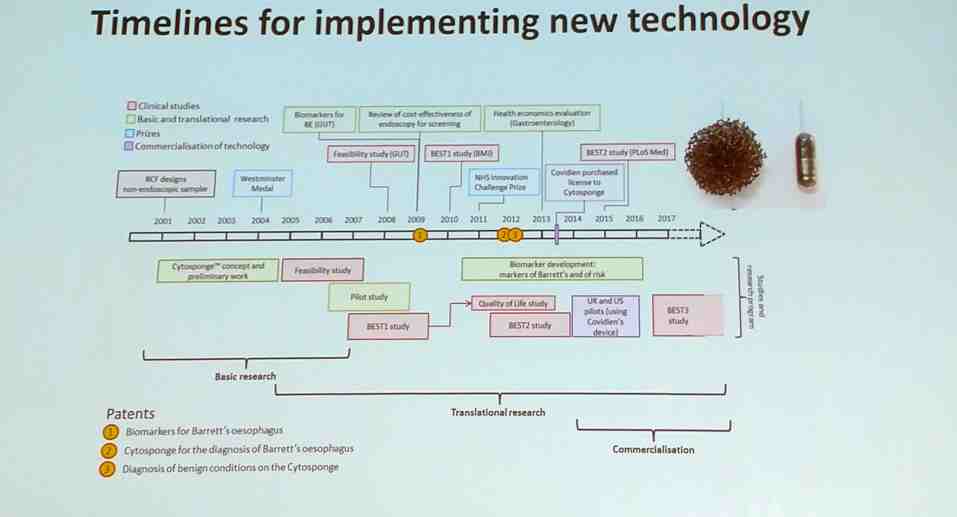
Since this is a new method of sampling, a clinical trial needs to be done that will prove that the method works, second a more simple procedure needs to be approved for insurance coverage and then the general population of surgeons, pathologists and oncologists need to be convinced that the method works to sample the esophagus.
The process is complex and is shown below.
2019 02 04 cytosponge2

It is incredible that the amount of time this takes to implement and how much money and how many people may have been involved to bring it to the patient.
The easier step is to use the same histological biomarker that has been used to treat Barrett’s syndrome. The good news is that sometimes simple solutions yield great benefit and can provide good answers.
Similar Posts

  • | |

    Sleep apnea

    Sleep apnea is when sufferer stops breathing (apnea) at night as the muscles in the throat relax and then resumes when brain semi-awakes when the oxygen supply gets low to restore respiration. This happens tens to hundreds of times at night and can be debilitating when the disruption to sleep causes other health effects such…

  • Considerations for analysis of clinical samples

    When diagnostic tests are implemented in clinical studies there are multiple considerations beyond just the assay and the analyte that are not generally considered but are important. For example: Sample collection, preparation and transport Standards need to be specified for pre-analysis that would specify the conditions needed even before the analysis are done. Selection of…

  • Liquid biopsy guidelines

    A term that was created in 2010 called “liquid biopsy” became the standard for much of the screening of cancer that is done using blood to check for cancer cells though the NCI definition is specific for cancer and used to include its applications in detecting cancer and determining therapeutic efficacy : https://www.cancer.gov/publications/dictionaries/cancer-terms/def/liquid-biopsy The first…

  • Multi-cancer early detection

    There have been so many multi-cancer early detection tests coming on the market and the users are generally not aware of them – each of them have a different capability and strengths. Genomeweb had done a survey of what are the tests available and how they are perceived. Look at the survey at : https://www.genomeweb.com/cancer/genomeweb-survey-enthusiasm-mced-tests-research-and-clinical-care-despite-evidence-caveats…