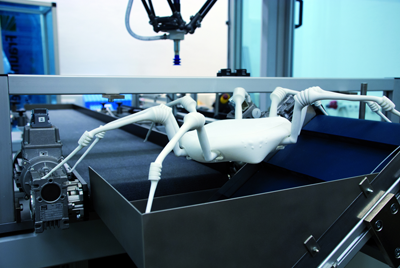
Spider robot molded cheaply

Cheap robots by the millions

Typically it costs many hundreds of dollars to make a robot that can do something substantial. However, researchers at the Fraunhofer institute have created molded or stamped robots that can be created very cheaply – they imagine them to be like disposable gloves. Make them, use them and then throw them away.

This is done through the process of selective laser sintering to shape the plastics for the robot by combining shapes and materials in a single component. This enables the robot to be built layer by layer into a final machine. Interestingly the animal that they chose to replicate is the spider!

https://www.lzh.de/en/publications/pressreleases/2012/weedcontrolwithoutchemicals
Similar Posts

  • |

    Mesoscale explorer

    Sometimes it is hard to imagine how many molecules are involved in a common biological pathway but there are thousands of molecules that orchestrate their chemical reactions to sustain life. One such area is the synaptic gap where messages are passed between neurons. This is a very active space where vesicle with messengers cross the…

  • Biology games

    There have been many games that have been developed to enhance the understanding of biology and not many of them are good. However, when they work well – like this example from the Nobel prize foundation that is illustrated below – they illustrate the concept well. One wonders how many of these games illustrate all…

  • |

    Muscarinic drugs and receptors

    There are many G-protein coupled receptors and one of the major categories for neurological drug development are called muscarinic receptors because they were first known to be activated by a mushroom alkaloid called muscarine. The isolation and characterization of muscarine was first reported by chemists in 1869! Muscarine works by mimicking the neurotransmitter acteylcholine on…

  • Polyphenols

    Polyphenols are a large family of naturally occurring compounds found in plants with two or more aromatic rings bearing one or more OH groups. They are divided into four main subclasses: Flavonoids : Quercetin (onions), catechin (tea), anthocyanins and kaempferol (Onions, berries, tea, dark chocolate) Phenolic acids: Caffeic acid, ferulic acid, ellagic acid, chlorogenic acid…

  • | |

    TDP43

    TDP43 (a nuclear DNA-RNA binding protein) is involved in splicing, RNA transport and stability in neurons. It was first identified as a pyrimidine rich TAR DNA sequence in HIV type 1 gene to modulate HIV gene expression. In 95% of the ALS patients, TDP43 is abnormal located within the cell and may also be aggregated,…