In summer 2012, Krainc’s lab published a paper on the biochemical cause for the link between Gaucher’s disease and Parkinson’s. It is known in the literature that Gaucher’s disease families have a higher incidence of Parkinson’s disease, however the reason was unknown.
Gaucher’s disease is an inherited disorder caused by the mutations of the GBA gene that codes for Glucocerebrosidase (GC). The patients with Gauchers disease have 2 defective genes whereas people in the familial lineage may be normal with a single defective gene. GC catalyzes the breakdown of glucocerebroside to Glucose and Ceramide in the lysosome and a lack of the enzyme leads to the accumulation of Glucocerebroside in the tissues.
Parkinson’s is a neurodegenerative disorder, clinically characterized by tremors, slowness and other movement disorders while biochemically accumulation of alpha synuclein(AS) in Lewy bodies has been observed in the neurons and probably an important reason for the neuronal dysfunction and toxicity.
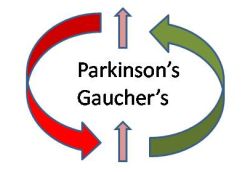
AS is degraded in the lysosome where GC is normally present. When GC is absent or present in smaller quantities, AS accumulates in the lysosome. In a positive feedback loop, the presence of AS decreases the function of the remaining GC and you get further accumulation of AS. Eventually, this may cause the destruction of the neuron.
It has been hypothesized that the accumulation of AS happens over time such that at a later age in life, enough AS has accumulated to cause obvious clinical symptom of the disease. The type of AS is also important since the insoluble fibrous material is more destructive than the soluble protein. Presumably, having soluble AS makes the neuron more susceptible to the fibrous AS. It is known that in mutations that cause 2 fold increase of AS, leads to a rapidly progressive Parkinsonism.
Thus, a positive feedback loop in this system could lead to a rapid development of the disease. It will be interesting to determine if there are small molecule compounds that enhance the degradation of proteins perhaps through stimulation of the Ubiquitin pathway.