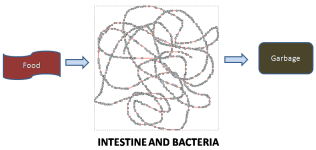
There have been several research publications that have tried to establish a link between immune system and gut microflora. The field has led to several confusing results, but a paper published in 2012 (Chung et al, Cell: 149, 1578) may help some of the confusion. They found that the maturation of intestinal immune system is dependent on what kind of bacteria are present in the gut. For example, bacteria from human or rat do lead to T cell expansion in the germ free mouse but taking mouse specific bacteria leads to expansion of the T cell population.
What does this mean?
It means that there is an intimate link between the bacterial types and the immune system. The implications could be many. For example, it is possible that what bacteria colonize our intestines are dependent on the environment that we grow up in… it is possible that the gut bacterial types change over time dependent on the food that we eat and the bacteria that we encounter or there might be a radical change after a course of antibiotics that kill a significant portion of the bacteria.
Does this have any significance for disease?
Probably. If your immune system that is responding to one kind of threat that is in a good balance now encounters another threat, it may be unable to deal with it. Or contrarily, having a immune system that is not exposed to any virulent bacteria has created a different population of T cells. These are just obvious conclusions but going beyond this it means that once the homeostatis has been setup between the bacteria in the gut and the immune system, it may be very difficult to dislodge the balance. Thus, the culture and fad of consuming healthy bacteria in yogurts or other potions might be completely useless, unless preceded by antibiotics or other dislodging agents. Do regular consumption of say lactobacilli change other characteristics and do they lodge in the gut after long periods of consumption? Unknown.
So what can be done for diseases which involve the immune system and the gut? Inflammatory Bowl disease is currently treated by immune-suppressing therapy and in extreme cases, by removal of the gut. There is a possibility that this can be treated by changing the colonization but it will need careful study to determine a) how to remove the current flora b) Colonize by flora that are compatible as well as less likely to trigger the immune system.
Obesity implications?
It is traditionally thought that the increase in obesity and diabetes is because of large supply of tasty food and lack of exercise are the main culprits. However, is it possible that the change in bacterial types colonizing our intestines have changed and led to the “epidemic”? The gut bacteria need source of energy and glucose to survive and generate metabolites. Do the bacteria consume more glucose now? Do they generate metabolites that lead to greater hunger response ? Good questions that need to be answered quickly.