Developing a simple device and a Biomarker takes effort

We had an interesting discussion with Dr Rebecca Fitzgerald, MD who is a Professor of Cancer Prevention at the University of Cambridge. Dr Fitzgeralds work aims to improve methods for early cancer detection for esophageal cancer through better understanding of the methods of molecular pathogenesis.
She has developed many methods to quantify biomarkers in Barrett’s syndrome. The tools that she used was simple and it works but it still takes significant development to bring it to medical practice.
Her method requires sampling the esophagus to find potential cancerous cells. The typical method would be do a biopsy in which a complex procedure will be performed on a subject to get a snip of a tissue from the esophagus and then perform an histological exam of the tissue.
Instead she developed in which a sponge is attached to a string and is swallowed by the patient. The string is then used to pull out the sponge and the cells that are attached to the sponge are sampled histologically.
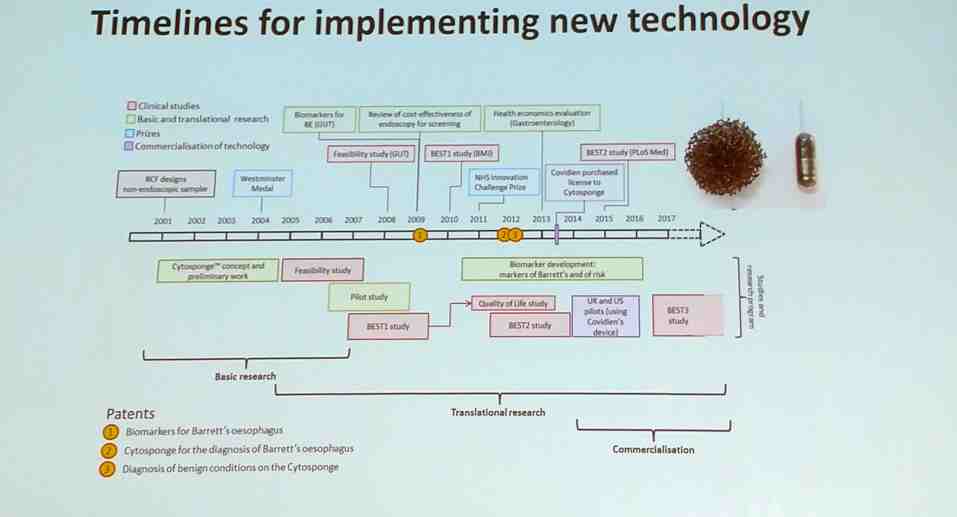
Since this is a new method of sampling, a clinical trial needs to be done that will prove that the method works, second a more simple procedure needs to be approved for insurance coverage and then the general population of surgeons, pathologists and oncologists need to be convinced that the method works to sample the esophagus.
The process is complex and is shown below.
2019 02 04 cytosponge2

It is incredible that the amount of time this takes to implement and how much money and how many people may have been involved to bring it to the patient.
The easier step is to use the same histological biomarker that has been used to treat Barrett’s syndrome. The good news is that sometimes simple solutions yield great benefit and can provide good answers.


Similar Posts

  • |

    Bisphenol A

    There is lot of information on BPA on wikipedia that talks about its use in plastics especially polycarbonates that are used in water bottle manufacturing. Polycarbonate bottles are transparent and can contain 90% BPA by mass It is not a plasticizer. The concern for its use comes from its effect as a weak xenoestrogen disrupting…

  • Acuity measurement

    How does a hospital measure the acuity of an illness? Acuity is defined loosely as the severity of an illness. The more severe an illness or malady is the more attention it deserves. For example, chest pain is critical and deserves attention vs. flu like symptoms do not deserve as much attention. A doctor in…

  • |

    Default mode network

    When we are not focused on a task, mind-wandering or just idling, specific regions of the brain such as medial pre frontal cortex, angular gyrus, hippocampus become activated and are called the default mode network. This is thought to be important for self referential thought, memory and future planning. It has been mapped with resting…

  • | |

    Hypertension

    There are many therapies for regulating high blood pressure. The one that has received some attention is the natural therapy by consumption of beet in various forms. Juice, raw, tablets, and cooked. The primary benefit appears to be conferred by the presence of nitrates, which enhance the amount of Nitric oxide present in blood and…

  • | |

    TDP43

    TDP43 (a nuclear DNA-RNA binding protein) is involved in splicing, RNA transport and stability in neurons. It was first identified as a pyrimidine rich TAR DNA sequence in HIV type 1 gene to modulate HIV gene expression. In 95% of the ALS patients, TDP43 is abnormal located within the cell and may also be aggregated,…