
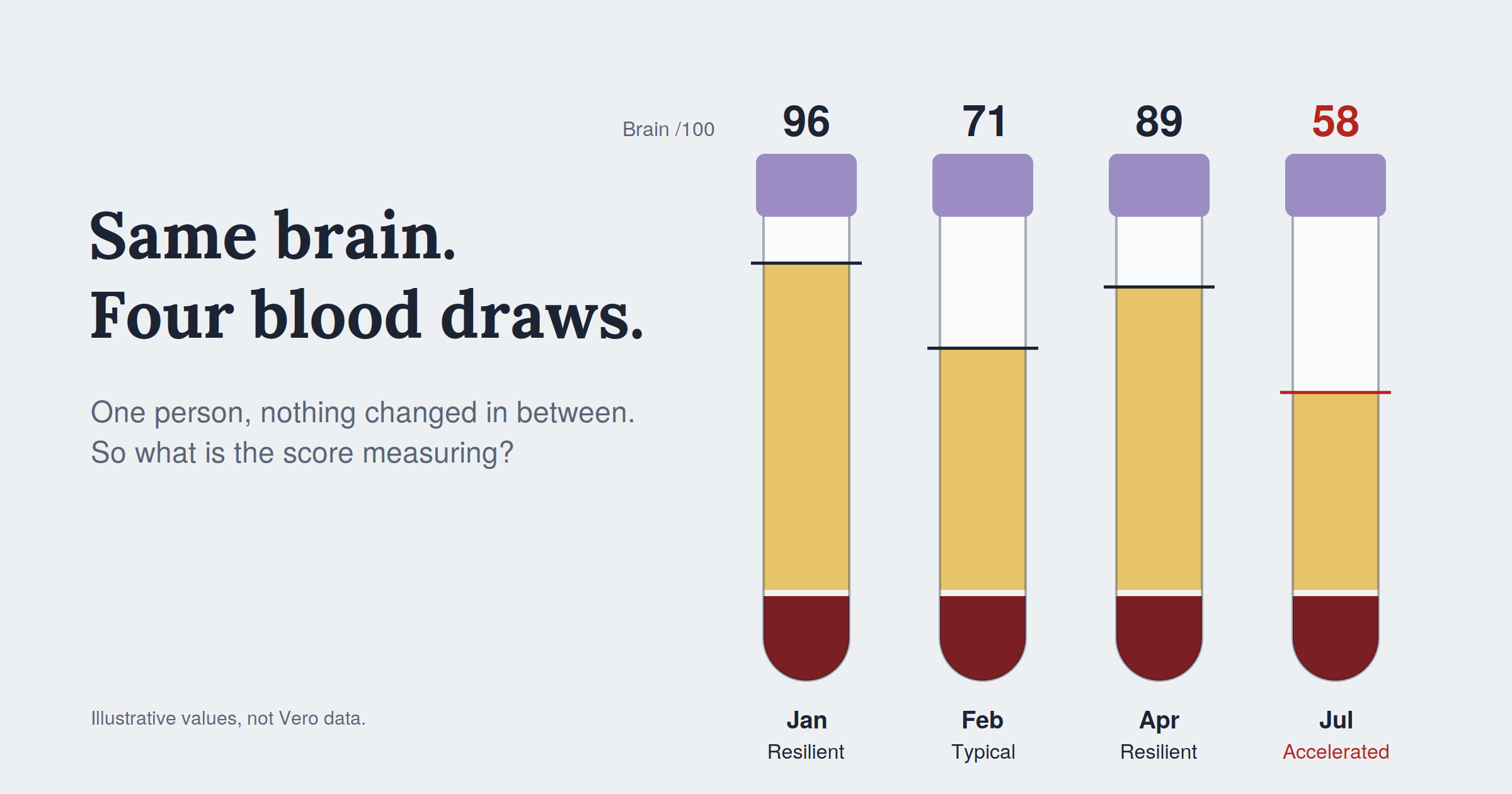
On Vero Bioscience’s homepage there’s a phone mockup that reads “Brain 96/100, Resilient.” I kept staring at it, because no score like that appears in the papers the company is built on. Those papers report age gaps in years and z-scores. Vero sells OrganAge, a blood test it says reads more than 11,000 plasma proteins and returns an age for 10+ organs. Right now it’s available only through research partnerships, with consumer launch planned for 2027 according to its FAQ. The science comes from co-founder Tony Wyss-Coray’s Stanford lab. The 2023 Nature paper measured 4,979 proteins on SomaScan and kept those whose genes are expressed at least four times higher in one organ than in any other in GTEx. It then trained a LASSO model per organ to predict chronological age. Your “organ age” is the difference between what the model predicts and how old you are. In 44,498 UK Biobank participants (Nature Medicine, 2025), an extremely aged brain carried an Hazard ratio of 3.1 for Alzheimer’s, about the same risk as one copy of APOE4. That’s a strong prognostic signal from just one tube of blood. Impressive enough that I want to investigate it more…
Like any general conclusion – when you ask what the score does for one person, things get complicated. Look inside the models. The heart model’s heaviest weights are NT-proBNP and troponin T, and the kidney model leans on renin. Your cardiologist can already order the first two. The number also moves with the assay. When the lab ran the same Stanford samples on SomaScan and Olink, organ age gaps correlated at r = 0.3 to 0.8 depending on the organ. The 2023 models were trained on 1,398 healthy people with a mean age of 75. The authors warned against applying them to young people and noted their cohorts skewed Caucasian. Vero’s site says 11,000+ proteins; the published models used about 5,000 and about 3,000. I couldn’t find where Vero says which model runs on which platform, or whether it was revalidated. Then there’s stability. In the 2025 paper’s longitudinal subset (a reduced 1,459-protein model), 68% of people flagged as extreme agers had lost that status at the next visit, about nine years later. Some of that is biology; the authors say they can’t yet separate it from technical noise. One more result should worry anyone building a consumer dashboard: youthful-looking arteries were linked to higher risk of type 2 diabetes and COPD. That should make us pause – why the disparity?.
In Pharma and Biotech we draw a hard line between prognostic and predictive biomarkers. A prognostic marker tells you who does badly. A predictive one tells you who responds to what you’re about to do. When used in clinical trials Biomarkers tell us about the drug or the efficacy. Vero’s evidence is prognostic. Every headline number comes from observational cohorts, and the FAQ says so plainly, which I respect. But the product, especially the Compass layer still in development, is pitched as a way to track how your organs respond to what you change. I found no published study that changed something in people, moved an organ age and then showed outcomes followed. My bet: a meaningful share of early customers will see an organ swing between “resilient” and “accelerated” within a year without changing anything. If Vero publishes test-retest variability by organ before launch, I’ll change my mind fast. Until then, here’s the question I’d ask before giving them my blood: what’s the coefficient of variation on my brain score if I come back in a month?