Image processing to kill weeds

laser_weed_killer

Not that it is difficult but if you have a garden and want to control weeds, the easiest method is to spray chemicals to kill the unwanted plants. More environmentally friendly measures take more time but it involves gardener’s sitting and picking up the unwanted plants. There are others who spray vinegar or acetic acid on the offending plants to kill them.

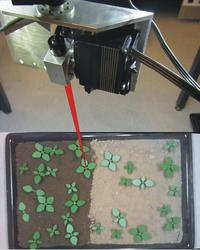
Researchers at Laser Zentrum Honnover e Vchose the difficult approach. They created a stereo camera that takes an image of an offending plant in the garden. Image processing using thresholding, filtering, edge detection finds the exact position of plant center. Once determined, a 10. 6 micron infrared carbon-dioxide laser fires a burst of energy to kill the plant.

The setup then moves on and targets the next plant. The system may not be economically viable but it is certainly accurate between 1-4 mm.

Imagine armies of the marauding laser wielding weeders in your garden soon.

https://www.lzh.de/en/publications/pressreleases/2012/weedcontrolwithoutchemicals
Similar Posts

  • 3D microscopy

    Super resolution microscopy One of the problems with Quantum dots and some fluorescent proteins/molecules is that they blink. And they all photo-bleach. Bayesian analysis of blinking and bleaching or 3B microscopy analyzes images using Hidden Markov Model (HMM) allows useful information to be extracted from the data. Dr Susan Cox has come up with unique…

  • Cell thickness measurement

    Cell change shape frequently as they move and divide but the measurement of the thickness is difficult. Current microscopy techniques can measure the dimensions in X and Y axis very accurately but cannot measure the cell thickness. Confocal microscopy, that is usually used with fluorescence dyes can measure the thickness of the cell but it…

  • Malaria games

    We think that image processing problems are difficult and interesting but there are others that elude us all the time. Malaria, a mosquito borne illness affects nearly 600,000 patients per day. The diagnosis unfortunately in many countries still uses the traditional Giemsa stain of blood. This requires a pathologist to study the slides and then…

  • 3D Scanning

    There are many ways to scan in 3D and there are many uses for scanning in 3D. One of the major ones has been geology and civil engineering. Imagine when you are making roads, the one thing that you require is the lay of the land. This will enable the building of roads that is…