Guinea worm disease or Dracunculiasis is a disease that has been around since a long time. The Guinea worm has been found on mummies and it has been mentioned in several holy books. Nowadays, it only exists in a few parts of Africa in very low amounts and is close to eradication.
Surprisingly, the eradication did not come from some new pharmaceuticals, new vaccine, new drug or even a new diagnostic. It really comes from understanding its life cycle and finding the cheapest solution to eradicate it.
Guinea worm spreads through water. The worm larvae are found in untreated water in the rainy season. These larvae are hosted in water fleas Genus Cyclops. As people ingest water contaminated by the copepods, the larvae enter circulation. Later in the stomach the fleas are digested by the stomach acid and the larvae are released. These larvae then infect the stomach and grow within the tissues of the body. Evolutionarily designed to spread, these worms then end of lower extremities causing significant pain and suffering. Near the feet, they emerge through a pustule, eliciting a feeling of intense burning. The instinct of the person is to dip the foot in water, which releases fresh larvae into the water body. The worm thus propogates the cycle.
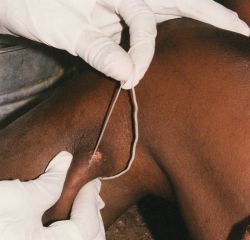
The eradication is come from the simplest means to stop the water cycle. As people stop drinking contaminated water the cycle of the worm is broken. All that is required is to convince people to drink water that has been filtered or boiled. In parts of rural Africa this has been implemented through feet-on-the-ground effort by several agencies requesting filtering of water, or distribution of filters, building and maintaining adequate drinking water supplies. The person who are infected are treated by gently removing the worm from the body over days or weeks coiling it onto a piece of wood/stick/plastic.
The almost complete eradication has been achieved without any drugs or modern medicine and makes one realize that understanding the parasite was important rather than billions of dollars in research in drugs, tests or vaccines. Though this will not work in every disease, it is important to understand that a) even a single infected cow, horse or other infected animal will re-initiate the cycle and b) diseases take a long time to disappear.