Garlic crush and sit rule

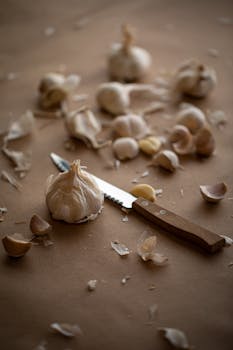
A close-up of garlic cloves and a wooden knife on a rustic brown surface, showcasing a warm and earthy kitchen setting.

More about garlic preparation. Garlin contains alliin stored in the cytoplasm which is converted by enzyme allinase, which is in the cell sap, to allicin which is the key sulfur compound responsible for its flavor and all the health benefits.

However to make the enzyme react, the crushing process needs to take place at room temperature and then allowed to mature which gives the enzyme a chance to break down allicin. Now, allicin is volatile and begins to form immediately after crushing and then peaks at about 10-15 minutes. So after crushing a few minutes are required before the enzyme gets a chance to act on alliin.

However, there is a catch. Allinase is a heat sensitive enzyme which means that no more allicin is produced after heating and implies that garlic needs to be crushed to release the enzymes and alliin and then should be left alone before cooking to form allicin.

The benefits of allicin is an antioxidant and antibacterial.

Similar Posts

  • ADHD

    Attention deficit hyperactivity disorder is thought to be neuro-developmental disorder that is thought to have a genetic component since it is heritable as shown from the twin and family studies. There are 3 core features that are used in diagnosis since it is not a single type of disorder but rather defined by DSM-5 classification…

  • |

    Sequencing

    It is amazing how good genetic sequencing is getting these days and reasonable enough to get 30x whole genome sequence that enables detailed analysis for a variety of conditions. The costs are so low that it is now possible for almost everyone to do it and also analyze the data. One provider with a catchy…

  • L-theanine

    It is surprising how much chemistry goes into understanding basic biology. Considering a simple cup of tea. There have been many studies showing the important bioactive compounds in tea. Catechins are polyphenols that got significant attention for their anti-oxidant activities. Then there is caffeine. But another component L-theanine has not been discussed much. L-theanine is…

  • Pharmacologically active constituents in plants

    There are many compounds in plants that are active in animals and humans. In broad category, all of these compounds listed below are listed. But, lets take it one at a time. Proanthocyanidins Cyanogenic glycosides Polysaccharides Glucosinolates Bitters Alkaloids Coumarins Saponins Phenols Volatile oils Flavonoids Tannins Anthraquinones Cardiac glycosides Proanthocyanidins: These molecules give the plants…