|

Neurological conditions

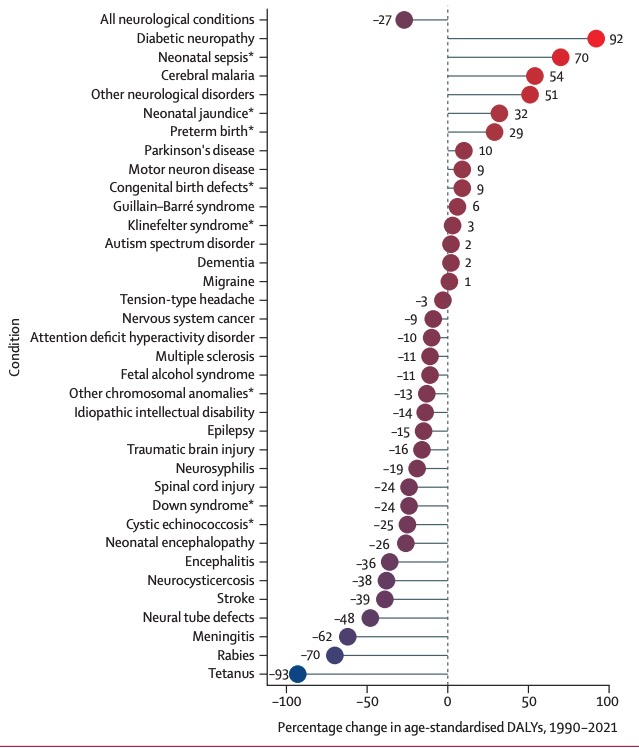
There has been changes in the neurological conditions overtime, and you might expect that many of the changes may have increased such as all the neurological disorders like Parkinson’s Alzheimer’s, but the true facts are a little different. For example, as expected, the diabetic neuropathy has increased, But what explains the increase in neonatal sepsis or cerebral malaria neo-natal jaundice?

Surprisingly stroke has been down along with meningitis rabies and tetanus. Meningitis rabies and maybe attributed to vaccines but stroke has also been lowered perhaps due to better diagnostics and treatment. Another interesting fact is that the conditions that are most prevalent are also a little unusual.
Screenshot


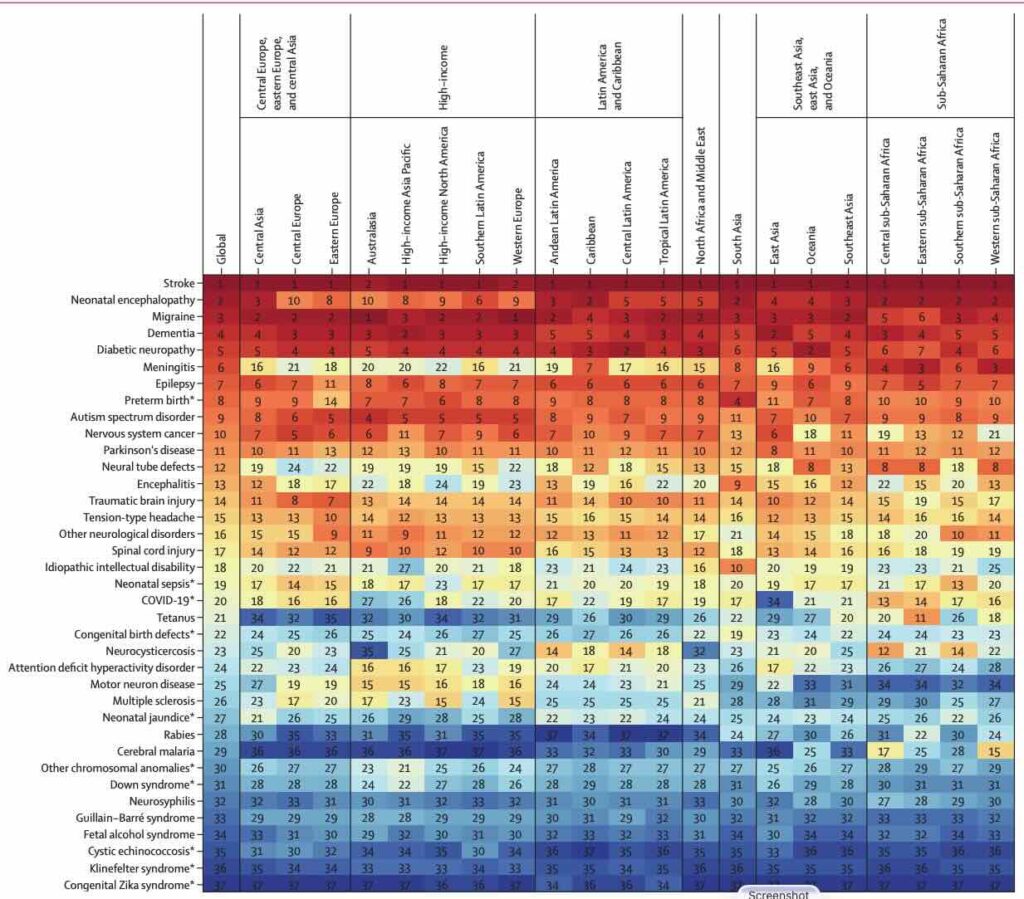
When we tried to measure the global burden of disease, the number one seems to be stroke it’s it’s true across many nations. The other higher ones are migraine dementia, and diabetic neuropathy as might be expected, but surprisingly some of the nervous system cancers are much lower perhaps because neuron is a non-dividing cell. With all the treatment options available, it is surprising that neonatal sepsis continues to be on the charts.


This lancet paper has more details: https://www.thelancet.com/journals/laneur/article/PIIS1474-4422(24)00038-3/fulltext

Similar Posts

  • | |

    TDP43

    TDP43 (a nuclear DNA-RNA binding protein) is involved in splicing, RNA transport and stability in neurons. It was first identified as a pyrimidine rich TAR DNA sequence in HIV type 1 gene to modulate HIV gene expression. In 95% of the ALS patients, TDP43 is abnormal located within the cell and may also be aggregated,…

  • Plant communication

    Plants communicate with each other. That much is known. However, what is not known is how plants communicate using symbiosis. Dr Johnson has reported new work in Ecology letters that shows that plants use symbiotic fungi to enable communication. Communication also causes interesting secretion by plants when infected by aphids. These secretions that are volatile…

  • |

    Schizophrenia drugs

    Schizophrenia is mental disorder characterized by problems in thinking, perception, emotions and behavior. It requires long term medication to manage symptoms. There are many drugs in the market to treat schizophrenia: Antipsychotics: These block the dopamine D2 receptor, though with side effects such as tremors and tardive dyskinesia. The Atypical antipsychotics affect both the dopamine…

  • |

    Adeno associated virus

    Adeno associated virus (AAV) has been one of major interests for gene therapy. AAV was discovered in 1965 as a contaminant of adeno virus and hence the name. It is 22nm and low pathogenicity because no polymerase and cannot replicate till there is co-infector. Genome map is 4.7kb. 145 nucleotides inverted terminal repeats at both…

  • |

    Open source protein models

    A company called Profluent (profluent.bio) has been developing protein models that can be used for designing new proteins (https://www.nature.com/articles/s41587-022-01618-2), modeling of new CRISPR-Cas sequences (https://www.nature.com/articles/s41586-025-09298-z) and developing LLM for protein generation (https://www.biorxiv.org/content/10.1101/2025.11.12.688125v1.article-info). What is amazing is that they have open sourced all their models and Profluent-E1 is available in GitHub to download and use. (https://github.com/Profluent-AI/E1)…