Relaxin is a 6kd 2 chain peptide hormone produced by ovary and placenta in females tha help remodel connective tissue but also promotes vasodilation and has cardioprotective and renoprotective effects in animal model via Nitric oxide pathway. Relaxin-2 signaling via GPCR RXFP1 has been investigated as a drug for its antifibrotic and vasodilatory actions.
RXFP1 in unique in that the GPCR it does not desensitize in females and it does not internalize. Because in pregnancy this should not get desensitized and it needs oto be present all the time.
A company called Tectonic therapeutics (https://tectonictx.com/#ourscience)
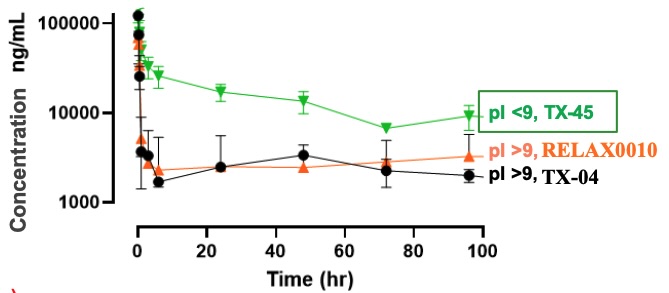
targeting pulmonary hypertension has modified relaxin coupling the 2 chains together and adding an Fc domain to make it protelytic resistant and increasing the half life. Specifically the LALAPG mutation also reduces binding to Fc receptors (https://pmc.ncbi.nlm.nih.gov/articles/PMC11407402/) However, due to residues in Relaxin its Isoelectric point is >9 which affects its half life. Changing the molecule’s amino acids changed the isolectric point and increased its half life. This molecule was now called TX45 and interestingly, it has 10 fold lower activity in vitro assays. However, when it is measured by in vivo assays, such as Renal arterial blood flow assay, it was found to be equally potent due to its longer half life in vivo.
So several creative steps:
- Deep understanding that increase relaxin’s half life was the key step
- In-vitro potency and in-vivo potency may be different but in-vivo is more important
- Fc region modifications to extend the half life
- Creative experiments to show the effect in an in-vivo model
- Deep understanding of protein biology and understanding that Isoelectric point is critical
This highlights that deep understanding of biology is required before sending a drug to clinical trials and sometimes basic understanding, such as understanding the Isoelectric point may make it more potent. The Tectonic team has a poster (https://tectonictx.com/wp-content/uploads/2025/04/tectonixtx-poster_ishlt-april-2025.pdf) which talks in detail. The team was also very creative in that they used anti mouse CD20 antibody to deplete all B cells and reduce generation of anti-drug antibodies (ADA response) n their mouse experiments.
Thus, after protein engineers have changed the molecule it became a better drug. There have been several studies by bigger companies that developed this molecule but they failed in clinical studies (Novartis and RELAX0010).
(The image is from Tectonic poster referenced earlier)